• All Access Login
  • Contact
TheMacU.com
  • Home
  • Free Lessons
  • Full Tutorials
    • Core Tutorials
      • macOS 26 Tahoe What’s New
      • macOS Core Concepts
      • iOS 26 What’s New
      • iOS Core Concepts
      • iPadOS Overview
      • iCloud for Mac, iPad & iPhone
      • Apple Intelligence
      • Apple Watch Core Concepts
      • Mac Backup
      • Mac Utilities
      • Mac Security
      • CleanMyMac X
      • Markup for iOS
      • iOS 18 What’s New
      • macOS Sequoia What’s New
    • Productivity Tutorials
      • Safari for Mac
      • Safari for iOS (iPad & iPhone)
      • Mail for Mac
      • Mail for iOS (iPad & iPhone)
      • Files for iOS
      • Contacts for Mac & iOS
      • Calendar for Mac & iOS
      • Reminders for Mac & iOS
      • Apple Maps for iOS & Mac
      • Notes for Mac & iOS
      • FindMy for iOS & Mac
      • Freeform for iOS & Mac
      • Health App Overview
      • Pages for Mac
      • Numbers for Mac
      • Keynote for Mac
      • Pages for iOS
    • Photography Tutorials
      • Photos for Mac
      • Photos for iPad
      • Photos for iPhone
      • iPhone Camera
      • iMovie for Mac
      • iMovie for iOS (iPad & iPhone)
      • Pixelmator Pro Essentials
      • Pixelmator for iOS (iPad & iPhone)
      • Preview for Mac
      • Photos for Mac – View & Organize
      • Photos for Mac – Edit & Share
    • Media & Entertainment Tutorials
      • Music App for Mac
      • Music App for iOS (iPhone & iPad)
      • Apple Music Service
      • AirPods Tutorial
      • iTunes for Mac
      • Apple Podcasts
      • Apple News
      • Apple Books
  • Testimonials
  • Memberships & Pricing
  • Click to open the search input field Click to open the search input field Search
  • Menu Menu
Mac, iPhone and iPad Tips!

iPad Video Tutorials That Actually Help

You can spend 20 minutes searching for an answer on your iPad and still end up more confused than when you started. One video skips steps, another moves too fast, and a third assumes you already know where every setting lives. That is why ipad video tutorials are only useful when they are built for real learning, not just quick demonstration.

For most people, the challenge is not a lack of information. It is a lack of instruction that is organized, visual, and easy to repeat. The iPad is designed to feel simple, but once you move beyond basic tapping and swiping, there is a lot to understand. Split View, Files, Notes, Safari settings, Photos organization, Apple Pencil features, iCloud syncing, privacy controls, and accessibility tools all have a learning curve. Good teaching shortens that curve.

What makes iPad video tutorials worth watching

A helpful iPad lesson does more than show a feature once. It explains what the feature does, why you would use it, and how to apply it in a real situation. That difference matters. If a video only demonstrates taps on a screen without context, it may look polished but still leave you unsure when to use the tool yourself.

The best tutorials move in a logical sequence. They start with the basics when needed, then build toward more capable use. For example, learning the Files app makes more sense when you first understand where documents are stored, how iCloud Drive fits in, and how folders behave across devices. Without that foundation, even simple tasks can feel unpredictable.

Pacing also matters more than most people expect. A lesson that is too slow can feel tedious, but one that races through menus is worse. iPad users often learn best when they can watch a step, pause, try it, and continue. That works especially well for settings changes, app setup, and workflow lessons where every small action affects the next one.

Why so many iPad lessons fall short

There is no shortage of free instruction online, but quality varies widely. Some creators know the iPad well but teach in an improvised way. Others are good on camera but skip the details that beginners actually need. The result is content that may be entertaining yet not especially effective.

One common problem is fragmented teaching. You might find one video on multitasking, another on Apple Pencil, and another on Notes, but nothing connects them into a usable system. That leaves viewers with isolated tips rather than real confidence. Knowing a handful of tricks is not the same as understanding how the iPad can support your day.

Another problem is assumption. Many videos are made for viewers who are already comfortable with Apple terminology and navigation. If you are not, phrases like drag and drop, app switcher, Stage Manager, or markup can slow you down before the lesson even begins. Strong instruction removes that friction by showing exactly what is happening on screen and keeping the language clear.

The best topics for iPad video tutorials

The most valuable lessons usually focus on tasks people repeat often. These are the areas where better instruction saves time and reduces frustration quickly.

Setup and settings are often the best place to start. Many users never revisit notification settings, privacy permissions, Focus modes, Safari preferences, or battery options after the first day. A clear walkthrough helps you make the iPad fit your preferences instead of adapting to defaults that may not serve you well.

Productivity tutorials are another high-value category. Notes, Reminders, Calendar, Mail, Files, and Safari can handle much more than basic use suggests. With proper guidance, your iPad can become a stronger tool for planning, reading, writing, scanning documents, and managing daily tasks. These apps are already on the device, which makes the learning especially worthwhile.

Photo and media lessons also tend to pay off quickly. Many people use their iPad for organizing photos, making simple edits, watching content, and managing personal media libraries. A good tutorial can show you how albums, search, shared libraries, markup, and basic editing tools work together so you spend less time hunting for pictures and more time using them.

For some users, accessibility and comfort features are the most important tutorials of all. Text size, display zoom, voice features, touch accommodations, and guided access can make the iPad far easier to use. These settings are often overlooked, yet they can dramatically improve the experience for older adults and anyone who wants the device to feel more manageable.

How to judge ipad video tutorials before you commit

Not every lesson deserves your time. A few signs can help you tell whether a tutorial is likely to be useful before you watch a full series.

First, look for structure. If the lesson title is specific and the description makes the outcome clear, that is usually a good sign. Broad promises often lead to shallow instruction. A video called something like organize files on iPad is usually more useful than one promising hidden iPad secrets.

Second, pay attention to whether the teaching is visual in a practical way. Zoomed-in interface details, highlighted clicks or taps, and clear on-screen callouts make a real difference on a device where menus can be compact. For iPad learning, production quality is not about style. It is about being able to see exactly what to do.

Third, consider whether the lesson seems scripted and intentional. That does not mean stiff. It means the teacher has thought through the sequence, the wording, and the goal. A methodical presentation helps viewers avoid guesswork, especially when they are trying to build skills step by step.

Learning styles matter more than people think

Some users want a fast answer and nothing more. Others want a complete path from beginner to confident use. Neither approach is wrong, but they serve different needs.

If you only need to turn off a setting or recover a missing toolbar, a short tutorial may be enough. But if you want to become consistently better with your iPad, single-topic clips can only take you so far. At some point, you benefit from instruction that connects features instead of treating each one as a separate trick.

That is where a library of lessons can be more effective than random searching. A structured set of tutorials helps you progress naturally from basics to everyday workflows. You stop solving the same confusion over and over because each lesson builds on the last.

For many Apple users, repeatability is the real advantage. Being able to revisit a lesson on split-screen multitasking, note organization, or iCloud file management is often more helpful than reading a one-time tip. Confidence usually comes from repetition, not exposure.

A practical way to get more from your iPad

If your iPad feels underused, start by choosing one area of improvement instead of trying to learn everything at once. That could be note-taking, file organization, photo management, email, or settings. Focused progress tends to stick better than scattered experimentation.

Then choose tutorials that match your current level. If you are still getting comfortable with gestures and navigation, advanced workflow videos may create more frustration than progress. On the other hand, if you already know the basics, beginner material may feel too limited. The right lesson meets you where you are and moves you forward clearly.

It also helps to practice while you watch. The iPad is a hands-on device, and passive viewing rarely leads to lasting skill. Pause often. Repeat steps. Make a small change in Settings. Create a folder in Files. Test a feature in Notes. Immediate use turns information into ability.

This is also why professionally built training stands out. When lessons are planned, clearly narrated, and visually guided, you spend less energy interpreting the instruction and more energy learning the device. That is a major reason many users prefer a dedicated Apple learning resource such as TheMacU instead of piecing together advice from disconnected sources.

The iPad becomes far more useful once the hesitation is gone. Good tutorials do not just explain buttons and menus. They help you feel steady, capable, and in control of a device you already own. That is usually the difference between occasionally using an iPad and genuinely relying on it.
May 7, 2026
https://themacu.com/wp-content/uploads/2026/05/ipad-video-tutorials-that-actually-help-featured.webp 1024 1536 Drew http://themacu.com/wp-content/uploads/2017/06/TMU.com-Header-logo-jpg-300x138.jpg Drew2026-05-07 03:48:422026-05-07 03:48:42iPad Video Tutorials That Actually Help
Mac, iPhone and iPad Tips!

iPhone Video Tutorials That Actually Help

Most people do not need more iPhone tips. They need someone to show them exactly where to tap, why a setting matters, and what to do next when the screen does not look the same as expected. That is why iPhone video tutorials remain one of the most effective ways to learn the iPhone. A good lesson removes guesswork, slows the process down, and turns a confusing feature into something you can use right away.

The problem is that not all tutorials teach in the same way. Some move too fast. Some assume you already understand Apple’s language. Others focus on flashy tricks but skip the basics that make the iPhone easier to use every day. If your goal is to become more confident, the format of the instruction matters as much as the topic itself.

Why iphone video tutorials work better than trial and error

The iPhone is designed to feel simple, but many of its most useful features are layered behind gestures, settings menus, and app-specific controls. You can often figure out the basics on your own, but that approach gets frustrating once you want to do anything more deliberate, like manage notifications, clean up Photos, organize Notes, or adjust privacy settings.

Video instruction helps because it shows the full sequence. You are not translating a written description into taps and swipes. You can see the exact path, the visual result, and the timing. That matters for beginners, but it is just as helpful for experienced users who know the device well enough to be efficient and want to stop wasting time hunting through menus.

There is also a confidence factor. When a tutorial is clear, you can pause, repeat, and follow at your own pace. That is a better fit for learning than trying to remember a dozen steps from memory or piecing together advice from short clips that only show part of the process.

What separates useful iPhone video tutorials from random tips

A useful tutorial is built around a task. It does not just say, “Here is a feature.” It answers a real question such as how to scan a document, share a password, recover deleted photos, reduce interruptions, or make text easier to read. That task-based approach is what makes the lesson practical.

Structure matters just as much. The best tutorials start with the outcome, move through the steps in order, and show the screen clearly enough that you can track what is happening. They also explain small details that often get skipped, such as where to find a setting if search does not surface it, what changes after a software update, or how one option affects another.

This is where professionally taught lessons have an advantage over quick social clips. Short videos can be useful for inspiration, but they often compress too much. You may see a result without understanding how to repeat it. For learning, clarity beats speed.

The best topics for iPhone video tutorials

Some iPhone subjects are especially well suited to video because they involve motion, interface changes, or a sequence of decisions. Settings tutorials are a strong example. If you are trying to control notifications, battery usage, Focus modes, privacy permissions, or accessibility options, seeing the path through Settings is more helpful than reading about it.

Photos is another category where video shines. Organizing albums, finding duplicates, editing images, and managing shared libraries all make more sense when you can watch the workflow. The same goes for Messages, Mail, Calendar, Notes, and Reminders, especially if you want to build habits around staying organized.

Security and privacy lessons are also valuable in video form because the stakes are higher. It helps to watch someone explain passcodes, Face ID, location settings, app permissions, Find My, and account protection carefully instead of trying to interpret brief instructions on your own.

There are times when written instructions are enough. If you only need to check a single setting or confirm a menu name, an article can be faster. But for anything multi-step, visual teaching usually wins.

iPhone & iPad iOS Tutorial

Get the most out of your iPhone or iPad with our Core Concepts video tutorial! Over 30 lessons!

How to choose iPhone video tutorials that fit your skill level

One of the biggest reasons people give up on learning is not that the material is too hard. It is that the lesson starts in the wrong place. A beginner does not need hidden productivity tricks before understanding the Home Screen, Control Center, app management, and basic settings. An intermediate user does not want a long explanation of how to open an app.

The best learning experience meets you where you are. If you are newer to the iPhone, look for tutorials that explain fundamentals without rushing. A good beginner lesson should assume nothing, use plain language, and show each step clearly. It should also avoid piling on too many extra options at once.

If you already use your iPhone comfortably, your needs change. You are probably looking for workflow improvements rather than orientation. In that case, the right tutorials will focus on organization, communication, productivity, photo management, file handling, and smarter settings decisions.

There is no single correct pace. Some learners want a broad overview first and details later. Others prefer one small task at a time. What matters is consistency. When lessons follow a logical progression, it becomes much easier to build confidence instead of collecting disconnected tips.

Why guided visuals make a difference

This is one detail people often overlook until they experience it. Screen recordings alone are not always enough. If the instructor taps quickly or multiple controls appear at once, it can still be hard to follow. Guided visuals such as zooms, callouts, highlights, and slow, deliberate demonstrations reduce that friction.

That kind of teaching is especially helpful for older adults, new Apple users, and anyone who has ever paused a video three times just to find the right button. It lowers the mental load. Instead of decoding the interface, you can focus on learning the action.

It also improves retention. When a lesson is visually directed, the sequence becomes easier to remember later. You are not just hearing instructions. You are associating the instruction with the location and behavior on the screen.

A practical way to use iPhone tutorials without getting overwhelmed

The easiest mistake is trying to learn everything at once. The iPhone can do a lot, but most people benefit more from mastering a few high-value areas first. Start with the places where confusion costs you time every day. That might be notifications, texting, photos, email, contacts, passwords, or calendar management.

Then learn in short sessions with a clear purpose. Watch a lesson, follow along on your own iPhone, and use the feature immediately afterward. If you only watch passively, the information fades quickly. If you apply it right away, it becomes part of your routine.

It also helps to revisit tutorials. Repetition is not a sign that you missed something. It is part of how people learn technology. A feature that seemed abstract the first time often clicks once you have a real reason to use it.

For that reason, a structured library of lessons tends to be more useful than isolated one-off clips. When tutorials are organized by topic and skill level, you spend less time searching and more time improving.

When free tutorials are enough and when a full library helps

Free lessons can be excellent for solving immediate problems. If you need to send a scheduled message, use Live Text, or manage app permissions, a single tutorial may be all you need. That is often the best starting point.

But if you regularly feel like you are only learning fragments, it may be time for a more complete system. A full tutorial library is helpful when you want to understand how the iPhone works across everyday tasks, not just fix one issue at a time. That includes learning how Apple apps connect, how settings affect each other, and how to build repeatable workflows.

This is where a platform like TheMacU fits naturally. Instead of relying on scattered tips, users can move through professionally produced Apple-specific lessons in a sequence that builds real competence. For many people, that is the difference between knowing a few tricks and actually feeling in control of the device.

What to look for before you commit to a tutorial source

Look for instruction that is specific, current, and paced for real people. The teacher should explain what they are doing, not just perform it. The screen should be easy to see. The lessons should be organized in a way that helps you progress from essentials to more advanced tasks.

You should also expect some acknowledgment that software changes. iPhone tutorials do not need to dwell on every minor update, but good instruction recognizes when menus move, names change, or new options alter the process. That is part of practical teaching.

Most of all, choose a source that respects your time. The right lesson gets you to a useful result without making you feel behind, confused, or dependent on guesswork.

The best iphone video tutorials do something simple but powerful. They replace hesitation with clarity. Once that happens, your iPhone stops feeling like a device full of hidden features and starts feeling like a tool you can actually use with confidence.

Mac, iPhone, iPad Tutorials. membership options

May 6, 2026
https://themacu.com/wp-content/uploads/2026/05/iphone-video-tutorials-that-actually-help-featured.webp 1024 1536 Drew http://themacu.com/wp-content/uploads/2017/06/TMU.com-Header-logo-jpg-300x138.jpg Drew2026-05-06 03:54:422026-05-14 18:12:18iPhone Video Tutorials That Actually Help
Mac, iPhone and iPad Tips!

Mac Video Tutorials That Actually Help

A lot of Mac users do not need more tips. They need clearer teaching.

That is the real gap most mac video tutorials fail to address. You open a lesson because you want to organize photos, clean up your desktop, manage iCloud storage, or understand Safari settings. Instead, you get a fast screen recording, vague narration, and a handful of skipped steps that leave you pausing, rewinding, and guessing. The problem is not your ability. The problem is instruction that was never designed for real learning.

What good mac video tutorials should do

A useful tutorial should remove friction, not add more of it. That sounds obvious, but many videos are built for speed or entertainment rather than understanding. They show what to click without explaining why it matters, when to use it, or what might look different on your Mac.

Good mac video tutorials are structured around tasks people actually need to complete. That might be setting up Mail, creating folders in Notes, adjusting privacy settings, editing a video in Photos, or learning how Finder works. The lesson starts with a clear goal, moves in a sensible order, and shows each action closely enough that you can follow along without strain.

That structure matters more than many people realize. Mac users often feel stuck not because Apple devices are too complex, but because knowledge is fragmented. You may know how to AirDrop files but not where downloads are saved. You may use Reminders every day but never realize how much more useful smart lists can be. A strong tutorial closes those gaps step by step.

Read more

May 5, 2026
https://themacu.com/wp-content/uploads/2026/05/mac-video-tutorials-that-actually-help-featured.webp 1024 1536 Drew http://themacu.com/wp-content/uploads/2017/06/TMU.com-Header-logo-jpg-300x138.jpg Drew2026-05-05 16:56:562026-05-05 17:14:13Mac Video Tutorials That Actually Help
Free iOS Lessons

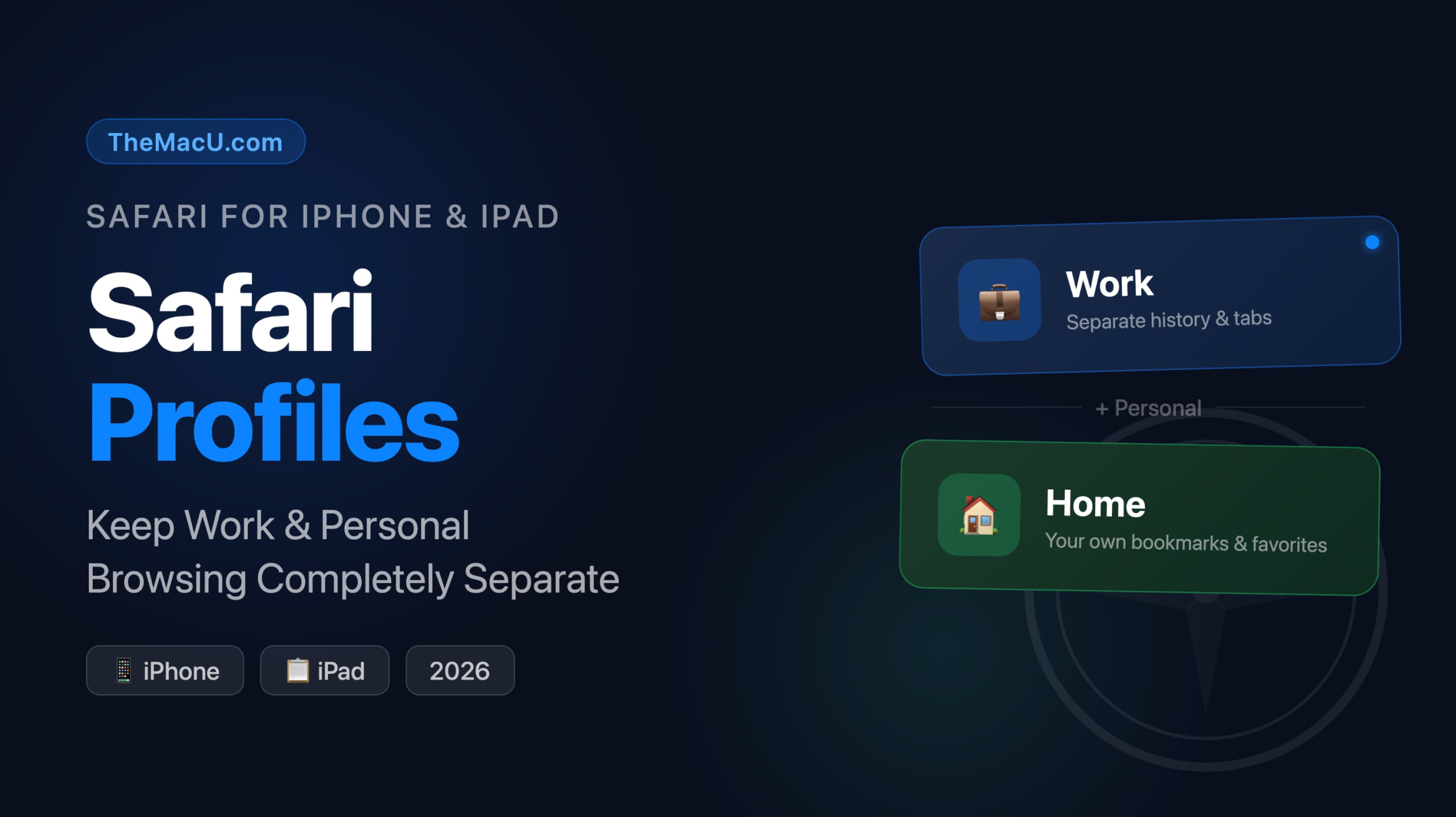
Safari Profiles on iPhone & iPad — Keep Work & Personal Browsing Completely Separate!

video
play-sharp-fill

In this lesson from the full Safari for iOS Tutorial, we’ll show you how to set up and use Safari Profiles on your iPhone and iPad to keep your browsing life organized. Create separate profiles for Work, Home, School, or anything else — each with its own bookmarks, history, tabs, and Tab Groups. We’ll walk you through creating your first profile, adding an icon and color, switching between profiles in Safari, and removing a profile when you no longer need it.

Read more

May 2, 2026
https://themacu.com/wp-content/uploads/2026/04/safariprofiles_Splsh-scaled.jpg 1436 2560 Drew http://themacu.com/wp-content/uploads/2017/06/TMU.com-Header-logo-jpg-300x138.jpg Drew2026-05-02 16:33:432026-05-02 16:37:11Safari Profiles on iPhone & iPad — Keep Work & Personal Browsing Completely Separate!
Page 3 of 3123

All Access

View our comprehensive collection of Mac, iPad, and iPhone tutorials today! We offer a range of membership options, all starting with a free trial!

Start your Free Trial!

Search Topics

Search Search

Topics

Apple Intelligence Apple Maps Apple Music camera desktop Finder High Sierra iCloud iMac iMovie iOS iOS 11 iOS 12 iOS 13 iOS 14 iOS 15 iPad iPadOS iPad Pro iPhone iPhone 11 iPhone 12 iPhone X Luminar Mac Macbook Macbook Air MacBook Pro Mac Mini macOS macOS Catalina Mail Maps Mojave Music Notes Photo Editing Photo Enhancement Photos Safari Settings Sierra tips troubleshooting tutorial

Archive

Free Lessons!

  • How to Set Up Emergency Contacts & Medical ID on iPhone
    How to Set Up Emergency Contacts & Medical ID on iPhone!May 25, 2026 - 4:03 pm
  • Apple Maps for Mac: Master Places, Pinned Locations & Custom Guides! Step by Step Tutorial.May 10, 2026 - 4:40 pm
  • Safari Profiles on iPhone & iPad — Keep Work & Personal Browsing Completely Separate!May 2, 2026 - 4:33 pm
  • How to Use the Info Panel in Apple Photos for Mac: View, Edit & Organize Your Photo DetailsApril 19, 2026 - 5:21 pm
  • Remove photos from your Main Library when they are in an Album! Apple Photos Lesson for Mac & iOS!April 11, 2026 - 5:28 pm
  • How to add subtasks in Reminders for Mac! Step by Step Tutorial.April 8, 2026 - 10:30 pm
  • Organize Reminders with Lists, Sections & Groups – Apple Reminders App Tutorial!March 29, 2026 - 4:46 pm
  • panorama photos - iPhone Camera tutorial
    How to shoot fantastic Panorama Photos with iPhone Camera. Horizontal + Vertical!March 19, 2026 - 5:21 pm
  • what are photo bursts on iphone
    What Are Photo Bursts on iPhone and Why You Should Use ThemMarch 19, 2026 - 2:18 am
  • How to use Tags to label & organize files or Folders on a Mac! macOS Tutorial.
    How to use Tags to label & organize files or Folders on a Mac!March 11, 2026 - 11:25 pm
  • How to add events & reminders in the iOS Calendar App. iPhone & iPad Tutorial!March 6, 2026 - 6:39 pm
  • How to use the look around feature in Apple Maps for Mac to tour cities and towns around the world!February 25, 2026 - 9:29 pm
  • How to operate the Flash on iPhone Camera!February 23, 2026 - 11:50 pm
  • control center customization tutorial for Mac
    How to customize Control Center in macOS 26 & Later!February 20, 2026 - 8:58 pm
  • Learn to manage the previous recipients list in the Apple Mail App for Mac!February 16, 2026 - 9:45 pm

All Access

  • Tutorials Browser
  • Account

Browse

  • All Tutorials
  • Core Tutorials
  • Productivity Tutorials
  • Photography Tutorials

Blog

  • Free Apple Watch Lessons! (4)
  • Free iOS Lessons (150)
  • Free Mac Lessons (162)
  • Mac, iPhone and iPad Tips! (39)
  • News (101)
  • Recommended Items (3)
  • Uncategorized (73)
  • Updates (95)

About & Info

  • Contact
  • About
  • Partners & Affiliates
  • Group Memberships
SwansonDigital, LLC Ltd. All Rights Reserved. TheMacU.com has not been sponsored, or otherwise approved by Apple Inc. - Enfold WordPress Theme by Kriesi
  • Link to Facebook
Scroll to top Scroll to top Scroll to top